
As yet another major UK university announces significant course closures and redundancies – mainly affecting arts and humanities – it’s worth being reminded that entries for A level arts subjects: dance, design & technology, drama, music among others, have reached the lowest since at least 2011.
Exactly ten years ago, I presented at an arts conference and wrote an associated journal article ‘Predictive Texts’ that took a look into the future of the arts in the UK in 2026 based on the then current trends. I described a cultural landscape in which the arts had largely been stripped out of the educational experience of children and young people. I described the consequences of that policy on the live performing arts sector which was now being by-passed by a generation of students who had not received consistent, or in many cases any, arts education through primary and secondary education where the focus was on STEM education. I reflected on how that educational neglect had led to a kind of cultural blindspot or illiteracy which, in turn, had led to a severe decline in arts attendance as that generation of millenials now sought other avenues for their entertainment and spending.
There have been many dozens of articles written in the last few years voicing concern about state and future of the arts in the UK, particularly in education. Tory policy towards the arts threatened the existence of the entire creative sector, particularly those parts of the sector in which live performance is an integral part of their raison d’etre: live theatre, dance and music. Today, despite the change in government, almost daily there is news of another university cutting its creative and performing arts courses.
The decision to cut arts funding in higher education by the last Tory government signalled not only a drastic diminution of the arts in education but also, as a consequence of this and other policies, an acceptance that whole sections of the creative sector could be allowed ‘go to the wall’ despite the fact that the sector as whole contributes massively to the GDP. The contrast with the then government’s support of the fishing industry, which played such a huge role in Brexit, is stark. At present the fishing industry contributes around £0.5m to the economy. In contrast, the creative industries contribute around £146 billion to the economy (Gross Value Added data from the Office for National Statistics 2024 figures)
The 2024 election of the Labour Government and the accompanying positive statements about supporting the arts and creativity in education provided some indication of a change for the better (we’re still waiting). In the meantime a bleak future for the arts beckons. The creative industries are fed via a pipepline of skills and talent that are nurtured in our education system. Reducing or stopping the flow of creative talent along that pipeline ensures that the creative industries, and certainly those parts of the sector that are seen to be less ‘valuable’ in economic terms, wither on the vine. It also ensures that access to the arts and arts training increasingly becomes the preserve of the wealthy and privileged and those who have social, cultural and economic capital.
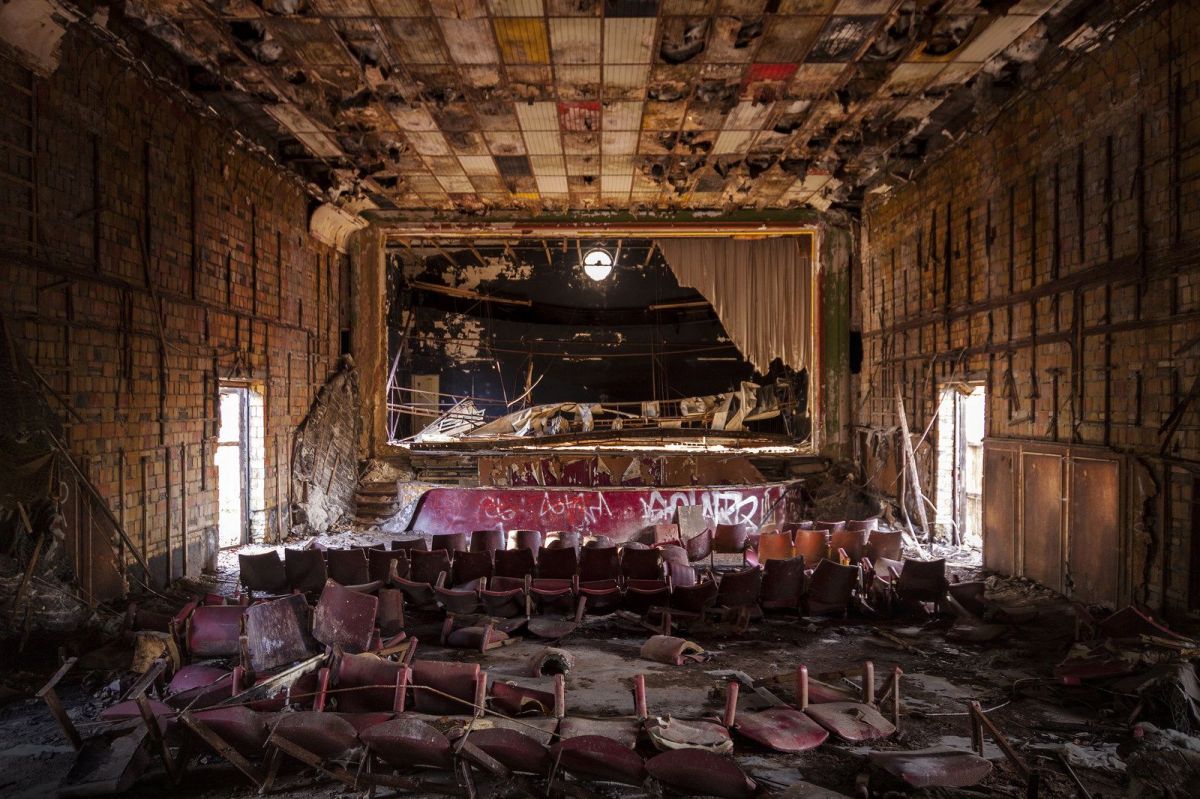
There’s a sentence from the 2015 book by the eminent producer and impresario Michael Kaiser titled ‘Curtains? The Future of the Performing Arts in America’ that sticks in the mind. Examining the trends, Kaiser describes a ‘doomsday scenario’ in which, across America, many theatres, arts centres and other performance venues, hit by the decline in audiences and/or funding, “sit vacant, reminders of a different era, not unlike the Colosseum in Rome and the Parthenon in Athens”.
Thinking about all this I was reminded of a book I read years ago, which remains one of my favourite books (it’s also on Neil Gaiman’s list of all-time favourites, so I’m in good company). The book is called Lud-in-the-Mist, written exactly 100 years ago by Hope Mirrlees. Mirrlees was a classicist, and much of her work dealt with the contested boundaries of Art and Life.
In Lud-in-the-Mist there are two countries. There is the land of Dorimare, a nation of stolid burghers, merchants and artisans. It’s a rather prim and very proper place, where everyone knows their place, where the motto is essentially ‘it’s the economy, stupid’, and where the arts are relegated to activities such as needlework and country dancing: pursuits for the refinement of gentlewomen and gentlemen.
On the border of Dorimare, however, on the other side of the Debatable Hills, lies the land of Faerie, a strange, dark land full of mysteries and wonders…not all of them pleasant. The upright citizens of Dorimare so fear the land that lies beyond those dread hills, that the word ‘Faerie’ is never to be uttered.
Dorimare’s main city of Lud-in-the-Mist lies at the confluence of two rivers: the Dapple and the Dawl. The Dawl is like any other commercial river, but the Dapple happens to flow out of the land of Faerie, and brings with it fairy fruit, that is smuggled into Dorimare. Eating fairy fruit has a terrible effect on the upright citizens of Lud-in-the-Mist: it causes people to start singing strange songs, to spout poetry, to dance with abandon. In other words, it turns them mad.
The plot revolves around the disappearance of a group of young ladies and the Mayor’s son who have been kidnapped and taken to the land of Faerie, and the attempt by the Mayor, a bumbling, self-important, rather fatuous man to rescue them. (Any resemblance to a real persons is entirely coincidental). As a consequence of that quest, fundamental changes are wrought – to the Mayor and to Dorimare itself.
In Lud-in-the-Mist, Mirrlees is dealing with the division of the world into Apollonian and Dionysian aspects: the homely and the wild. There is also the long battle between Classicism and Romanticism, and Freud’s theories of the conscious and unconscious mind, and the relationship between terror and beauty.
The actor Mark Rylance, in an interview, said that the arts are essentially ‘mysterious’ which is why they frighten politicians and policy-makers, because they can’t control them, they can’t measure them.
I imagine the educational curriculum in Dorimare’s schools is very much what like the one demanded by Gradgrind in Dickens’ Hard Times;
“Now, what I want is Facts. Teach these boys and girls nothing but Facts. Facts alone are wanted in life. Plant nothing else, and root out everything else. You can only form the mind of reasoning animals upon Facts: nothing else will ever be of any service to them.“
And if you think that’s rather extreme, consider this – handed to parents at a primary school in London:
‘The new programme of study in English is knowledge-based, this means its focus is on knowing facts rather than developing skills and understanding. It is also characterised by an increased emphasis on the technical aspects of language and less on the creative aspects.”
So, alongside schools dropping all ‘non-core’ subjects i.e. arts subjects and a few others from the school curriculum, we’ve also had catastrophic cuts to arts subjects in higher education in line with the political and ideological insistence that all higher education programmes must align with “economic and societal needs” – which successive governments have believed will only be met by STEM (Science, Technology, Engineering and Maths) programmes and some others such medicine and agriculture.
One can only look with envy at the financial support some other countries are putting into supporting their creative and cultural sectors as they recognise the importance and value of those sectors to the well-being of society as a whole.
I was thinking about Lud-in-the-Mist because it seems to me we are increasingly living in a country which is becoming more Dorimare-like by the day, where the arts are increasingly banished to the equivalent of the land of Faerie, where creativity is associated with the creation of goods and wealth, where any hint of an artistic or genuinely creative spirit is dismissed as bad influence, and to be actively discouraged and eliminated.
Across our education system, from primary through to tertiary, there is now a very real danger, evidenced by the course and departmental closures in higher education, the significant drop in the take-up of arts subjects, and the spectre of subjects like art, dance, drama and music disappearing entirely from the curriculum. The clear and present danger for the wider creative arts sector will be the cutting off the pipeline of interest, skills and talent on which the sector relies. We are facing the prospect, in many areas of the country, of the spectre of a cultural wasteland, not unlike Kaiser’s ‘doomsday’ scenario.
A hundred years ago, in Lud-in-the-Mist, Hope Mirrless asked how might we truly embrace the arts in all their wondrous, dangerous, life-affirming glory along with the eccentrics and mavericks? Or are we fated to banish them, their works and deeds, to that strange, wonderful, forbidden land beyond the Debatable Hills?
The final, celebratory chapter of Lud-in-the-Mist, as the citizens of Dorimare throw open the gates of the city to allow those mysterious, dangerous, life-affirming Faeries to enter, provides the answer.
Image: Abandoned Cinema by JOSOK
 Stumbling with Confidence